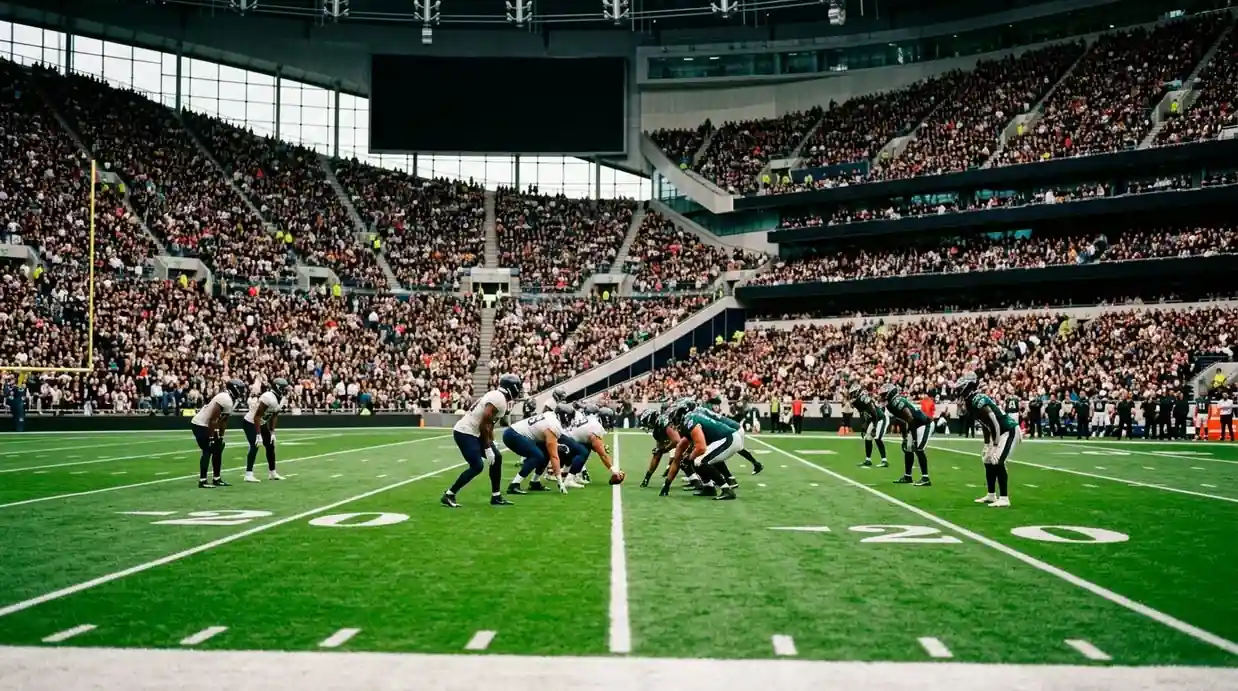
NFL Bet Types UK: Spreads, Moneylines, and Multi-Leg Wagers
 Available in US
Every NFL betting market tells a different story about the game. The moneyline asks who wins; the spread asks by how much; the totals ask how many points get scored. Learn to use all three, and you have a complete toolkit for every Sunday slate. Skip one, and you are leaving entire categories of value on the table.
I have been analysing NFL markets for UK sportsbooks for nine years, and the single biggest mistake I see from punters crossing over from football is treating the NFL like a two-outcome sport. It is not. The spread, which Americans call the “line” and UK sites label the handicap, is the central market around which everything else orbits. Once that clicks, the rest of the bet types fall into place remarkably quickly.
What follows is a practical breakdown of every major NFL market available to UK punters: how each one is priced, what the bookmaker is trying to do, and where the opportunities sit. We start simple and build outward. By the end, you will know why a seasoned NFL odds reader barely glances at the moneyline before drilling into the spread and the prop columns.
Table of Contents
- Moneyline Betting Mechanics: Backing Outright NFL Winners
- The NFL Point Spread: How Handicap Betting Actually Works
- Over/Under Totals: Betting on Combined Scoring
- Prop Bets: Player Specials and the Art of the Side Market
- Bet Builder and Same-Game Multi: Combining Markets in One Slip
- NFL Futures and Outrights: Backing a Winner Before the Season Ends
- Cash Out: Taking Control Before the Final Whistle
- NFL Bet Types: Your Questions Answered
Moneyline Betting Mechanics: Backing Outright NFL Winners
My first NFL bet, years ago, was a moneyline on a 3-point favourite. I won, felt clever, and then spent the next month trying to understand why the odds felt so compressed compared to backing a football team at similar odds. That compression is the moneyline in action. It is the simplest bet type on the board.
A moneyline (known as “match winner” or “match odds” on most UK sportsbooks) is a straight prediction: Team A or Team B wins the game. No spread, no handicap, no condition on the margin. If your team wins, you win. The complication is in the pricing.
NFL teams are rarely evenly matched. In a game where one side is expected to win by a touchdown or more, the bookmaker prices the favourite at short odds and the underdog at long odds. A team priced at 1/3 fractional (1.33 decimal) needs to win three times before you profit from a single losing bet. That asymmetry makes moneyline betting on heavy favourites a poor long-term proposition unless you have a very specific edge on outcome probability.
The stronger use case for the moneyline is backing underdogs at value. NFL upsets happen at a surprisingly high rate, the parity built into the salary cap and draft system means any given week can produce three or four results that confound the market. Picking the right underdog at 9/4 or 5/2, knowing your homework is solid, returns far better than grinding value on -150 American-equivalent favourites.
Practical tip from my own tracking: I record every moneyline bet with the implied probability the odds represented versus my assessed probability of the outcome. Over a full season, 2026 data from professional handicappers suggests the average win rate on NFL moneylines sits around 53 to 56 percent for disciplined bettors, which translates to a margin of two to three percentage points above what the market prices in. That is slim. Which is precisely why most serious NFL punters treat the moneyline as a secondary market, not the primary one.
On UK sportsbooks, the moneyline is usually listed alongside the handicap and total on the main NFL betting page. You will also find it bundled into Bet Builder selections, which is where it becomes genuinely useful. More on that in a later section. For now, understand the moneyline as the baseline: it tells you the market’s probability assessment in pure outcome form, and that information is valuable even when you are not staking on it directly.
The NFL Point Spread: How Handicap Betting Actually Works
The first time I explained the NFL point spread to a Premier League fan, he stared at me for a second and said, “So you are betting on the margin of victory, not who wins?” Essentially, yes. And once that lands, the spread becomes addictive in a way the moneyline never quite manages.
The point spread, listed as “handicap” on UK sportsbooks, is a line set by the bookmaker representing the expected margin of victory for the favourite. If a game shows Kansas City Chiefs -6.5 against the Raiders, the bookmaker believes Kansas City will win by approximately 6 to 7 points. Back the Chiefs on the handicap, and they need to win by 7 or more for your bet to settle as a winner. Back the Raiders at +6.5, and you win if they either win outright or lose by 6 or fewer.
The spread is priced at near-even odds on both sides, typically 10/11 fractional (1.91 decimal), because the bookmaker has calibrated the line to split public opinion. That is the structural challenge of spread betting: you are not just asking “who wins?”, you are asking “will the favourite win by more than this number?” Both questions require different analysis.
Key numbers matter enormously in NFL spread analysis. Historical data tracked by Covers.com over multiple seasons shows that approximately 15 percent of NFL games end with a 3-point margin and around 9 percent with a 7-point margin. These are the two most common final score differences in the sport, driven by the scoring structure. A field goal is worth 3 points, a touchdown with conversion is worth 7. This means a line sitting at -3 or -3.5, or at -6.5 or -7, has disproportionate significance. Moving from Chiefs -3 to Chiefs -3.5 is not a half-point change in abstract terms; it crosses a key number that lands roughly one in six games.
Professional bettors place enormous weight on where the line opens versus where it closes. The opening number reflects the bookmaker’s initial assessment; line movement from there is driven by sharp money, injury news, and weather reports. Buying into a line that has moved significantly without new information is often a mistake. Following sharp movement from well-capitalised professional bettors who have pushed the line with purpose is a different matter.
For UK punters, the spread is also available as a live/in-play market during the game, which opens up an entirely different set of strategies. The live spread moves with the score, quarter, and down-and-distance situation in real time. When a team falls behind unexpectedly in the first quarter, the spread on their recovery can offer the kind of value the pre-game market rarely produces. That dynamic is explored more deeply in a dedicated live betting guide, but the principle is the same: understand the spread, and you understand the engine driving the market.
One more thing worth noting for punters coming from UK football markets: the spread exists specifically because the NFL is a sport with wide score variance. A team can lose by 3 or by 24 depending on turnovers and special teams. That volatility is what makes the handicap both the hardest and most rewarding market to beat consistently.
Over/Under Totals: Betting on Combined Scoring
There is a version of NFL betting where you do not care which team wins. You are simply watching the scoreboard, counting points, and waiting to see whether the total lands over or under the line. I have had some of my cleanest analytical wins on totals markets, partly because the public tends to over-focus on spread and moneyline, leaving the over/under a little less efficient.
The totals market, also labelled “over/under” on UK sportsbooks, sets a combined points line for both teams. If the bookmaker posts a total of 44.5 for a game, you are backing either “over 44.5 points” or “under 44.5 points.” Your bet wins if the final combined score lands on the correct side of that line. Whether it is 28-17 (45 total, over) or 17-14 (31 total, under) is irrelevant. Only the aggregate matters.
Totals analysis draws on a different set of variables than spread analysis. Offensive line health, defensive pressure rates, weather conditions (cold, wind over 15mph historically suppresses scoring), pace of play, and the specific defensive matchups in a game all factor in. A team ranked top-five in sack rate playing against a slow-footed quarterback in a January freezer game in Buffalo is a classic “under” setup. The conditions and matchup both push towards low scoring.
The average NFL game in the 2025 season attracted approximately 18.6 million viewers per game in the US, with league scoring averaging around 47 to 49 points combined, explaining why so many totals are posted in the 44 to 50 range. But averages obscure the range. Division games in bad weather can produce totals in the mid-30s. Shootout matchups between two pass-happy offences with weak secondaries can clear 60. Understanding which game you are looking at — and whether the posted total reflects that reality — is where the work lies.
One practical note on totals for UK punters: many sportsbooks offer first-half totals and individual quarter totals as separate markets. First-half totals can be particularly interesting because they isolate the early-game scripting, since teams tend to play more conservatively in the second half when protecting a lead, which can skew the full-game total in ways the first-half line does not fully price.
Prop Bets: Player Specials and the Art of the Side Market
Prop bets, called “player specials” or “player markets” on many UK sportsbooks, are where the NFL betting menu turns into a research playground. I log more hours per week on prop analysis than on spread analysis, and I do not think that is unusual among punters who have been doing this for a while. The markets are deeper, the inefficiencies are wider, and the skill curve is steeper in the right direction.
A prop bet is a wager on a specific outcome within a game that does not depend directly on the final result. Player props are the most common type: will Patrick Mahomes throw for over 275.5 passing yards? Will the anytime touchdown scorer be a wide receiver or a running back? Will a specific player record over 6.5 receptions? Game props are a related category — will there be a safety? Will overtime occur? What will be the first scoring play of the game?
Anytime touchdown scorer is consistently the most popular prop market for UK punters, partly because it mirrors the goalscorer markets that football bettors already understand. The logic is similar: identify a player with high red zone usage who is priced as an underdog to score. Running backs with heavy short-yardage workloads, tight ends who operate near the goal line, and receivers who run high-percentage routes inside the 10-yard line are the usual candidates. The key metric is red zone target share, not overall target share.
Yardage props, passing yards, rushing yards, receiving yards, require a slightly different framework. These markets are priced based on projected workload and efficiency. If a receiver’s yardage line is set at 62.5 receiving yards but the defence he is facing gives up 85 yards per game to that position, the over carries structural value before you factor in anything else. Closing line value (CLV) is the best proxy. Whether the line moved in your favour between when you placed the bet and kick-off for whether you have identified a real edge here. The flexibility principle matters: the best value in NFL betting rarely sits in the same market week after week. One week the spread is priced inefficiently; the next it is a specific yardage prop that has not been sharpened by the volume of action the main markets receive.
The practical limit of prop betting for UK punters is that not all markets are available on all platforms, and max stakes on props tend to be significantly lower than on main markets. Sportsbooks are well aware that player props are more exploitable than spreads, and they manage their exposure accordingly. That said, the range of markets available has expanded substantially since the NFL’s TV deal with Channel 5 brought the sport to a wider UK audience.
Bet Builder and Same-Game Multi: Combining Markets in One Slip
The Bet Builder, also called “same-game multi”, was the product that changed how casual UK punters engage with NFL. Before it existed, you could either back a spread, a total, or a moneyline. The Bet Builder lets you combine selections from the same game into one slip, with odds multiplied. The catch, and it is a real one, is that correlated outcomes within a single game cannot be genuinely independent, and the bookmaker prices accordingly.
A Bet Builder works like this: you pick, say, the Chiefs -3.5, over 46.5 total points, and Patrick Mahomes over 275.5 passing yards — all from the same game, all combined into one bet. If all three legs win, you collect at the combined odds. If any one leg loses, the entire slip loses. The odds are generated dynamically by the platform based on the correlation between your selections.
The correlation issue is what makes Bet Builder construction a genuine skill. Some combinations are positively correlated in a way that the market already prices in. If you expect a high-scoring game, backing the over and backing a high passing yards total is essentially the same thesis expressed twice. The bookmaker knows this and will reduce the odds multiplier accordingly. Smarter Bet Builder construction looks for combinations that are less obviously correlated: a team to win and cover combined with a player from the opposing team to have a strong individual performance, for instance.
From a practical standpoint, the Bet Builder is most useful when you have a specific game narrative in mind that spans multiple markets. The 2026 NFL season saw several platforms offer Bet Builders with 10 or more legs available per game, including player props, team totals, and even drive outcomes. The flexibility is substantial. What it is not is an automatic value-generator. The house still builds in margin at the leg level, and combining four low-edge selections does not produce a high-edge combined bet.
Same-game multi is the term you will see on some platforms (notably those with an American betting influence). The mechanics are identical to Bet Builder. The difference is cosmetic — a naming convention that signals which side of the Atlantic the product architecture came from. Either way, the underlying maths is the same, and the approach to building one intelligently does not change.
The Bet Builder’s best use case, in my experience, is to combine a high-conviction primary selection (say, a spread or total where your research points clearly in one direction) with a low-correlation prop that enhances the return without meaningfully increasing your analytical uncertainty. One strong leg and one supplementary leg, not five legs you are half-sure about.
NFL Futures and Outrights: Backing a Winner Before the Season Ends
NFL futures, listed as “outrights” or “ante-post” on UK sportsbooks, are season-long or event-long bets placed before the relevant period begins. The Super Bowl winner market opens before the season kicks off and closes at kick-off of the championship game itself. Division winner markets, conference winner markets, and awards like MVP and Defensive Player of the Year all fall under the futures umbrella.
The main structural advantage of futures betting is that early-market prices often contain more value than in-season prices, because the bookmaker is pricing under greater uncertainty. A Super Bowl winner backed at 12/1 in July can move to 7/2 by November if the team is performing well — which means your original position is sitting at significant unrealised profit before the season is even over. The disadvantage is capital lock-up: your stake is tied up from the moment you place the bet until the market settles, which can be six months or more.
Futures markets are a separate discipline from game-by-game wagering, requiring a different research framework and much longer time horizons. If you want a deeper breakdown of how to approach NFL futures and outrights across the full season, the division winner, conference, and Super Bowl markets are covered in detail separately. The short version for this context: futures are legitimate and widely used, but they reward different skills than spread betting — patience, roster analysis, and a tolerance for long holding periods.
Cash Out: Taking Control Before the Final Whistle
Cash out is not a bet type in the same sense as the others on this list: it is a feature that modifies how an existing bet can be settled. Most major UK sportsbooks offer cash out on NFL spreads, totals, and Bet Builders, allowing you to accept a guaranteed return before the game concludes in exchange for giving up your chance at the full payout.
The cash out value offered at any given point reflects the bookmaker’s live re-pricing of your selection minus their margin. If you backed a team to cover a spread and they are dominating midway through the fourth quarter, the cash out value will be high — close to, but always below, the full payout. If the game has turned against your selection, the cash out will return a fraction of your stake. The decision is yours: lock in the bird in hand, or let it ride.
Used intelligently, cash out serves a specific risk-management function. I use it in two situations: when the fundamentals of my original thesis have materially changed (a key player is injured, the weather deteriorates, momentum has clearly shifted), or when the locked-in return represents a genuinely good price given the remaining risk. What I avoid is using it purely out of nerves or to guarantee a small profit on a bet that still has logical grounds to succeed. Sportsbooks profit on cash out because punters tend to sell too early and at too high a discount. The integration of live streaming in betting platforms has been shown to increase engagement by around 25 percent — and a lot of that engagement comes through cash out decisions made in the heat of the moment rather than rationally.
NFL Bet Types: Your Questions Answered
The most common questions I receive from UK punters new to NFL betting cluster around the same few points of confusion. Here are the ones worth addressing directly.
What is NFL handicap betting and how does the point spread work?
NFL handicap betting (called the point spread in the US) assigns a virtual points advantage or disadvantage to each team. If the Chiefs are -6.5, they must win by 7 or more for a handicap bet on them to win. The Raiders at +6.5 win the handicap bet if they either win outright or lose by 6 or fewer. Most UK sportsbooks price both sides at 10/11 (1.91 decimal), reflecting near-equal probability once the spread is applied.
What are the most popular NFL prop bets for UK punters?
Anytime touchdown scorer is consistently the most popular NFL prop in the UK, mirroring the goalscorer market in football. Yardage props — passing yards, rushing yards, receiving yards for named players — are the next most common. Player receptions markets (over/under a set number of catches) have grown significantly since 2024, partly driven by increased roster familiarity among UK fans following Channel 5 coverage.
How does the NFL Bet Builder differ from a regular accumulator?
A regular NFL accumulator combines results from multiple separate games — each leg is independent. A Bet Builder (or same-game multi) combines selections from within the same game, such as the spread, a player yardage prop, and a touchdown scorer. The odds are adjusted for correlation between legs within the same game, whereas a traditional accumulator multiplies odds directly across independent events.
What is a same-game multi and how is it priced?
A same-game multi is the equivalent of a Bet Builder — the terminology differs by platform. Selections from a single game are combined, with the platform applying a correlation adjustment to the odds. The more the legs are positively correlated (e.g., team to win big and total points over), the more the combined odds are reduced compared to a simple multiplication. Platforms calculate this dynamically using proprietary models.
Created by the ”Bets for nfl” editorial team.