Super Bowl Betting UK: Outright Winner Odds and Prop Markets
 Available in US
Super Bowl LIX in February 2025 was watched by 127.7 million people globally, the most-watched sports broadcast in recorded history per Nielsen. In the UK, the story was similar in scale and trajectory: Sky Sports averaged 514,000 viewers for Super Bowl LVIII the previous year, up 49 percent year on year, with ITV drawing 555,000 at its peak. The under-35 demographic in the UK grew 91 percent in a single year. These are not the audience numbers of a niche transatlantic curiosity. The Super Bowl is now a major UK sporting event. The betting market around it reflects that.
What makes the Super Bowl uniquely interesting from a UK punting perspective is the sheer breadth of markets available. This is not just a game you can back on the spread or the total. It is an event where a serious punter can operate across dozens of distinct markets: from the winner outright to the MVP, individual player yardage props, and novelty specials on the halftime show. Understanding the structure of those markets, how they are priced relative to each other, and where the efficiency gaps tend to appear is the core of Super Bowl preparation.
The game kicks off around 23:30 UK time. Most live betting action runs from midnight into the early hours of Monday morning. For many UK punters, the pre-game markets are where the majority of serious work gets done. The live play is often more about entertainment than systematic edge-seeking by that hour. Here is how I approach it.
Table of Contents
- Super Bowl UK Audience: Exploiting Deepened Betting Markets
- The Super Bowl Winner Market: Where Timing Matters Most
- Super Bowl MVP Betting: The Market Within the Game
- Super Bowl Props: The Broadest Market Menu of the Season
- Futures and Ante-Post Super Bowl Markets: Conference Winner, Division, and More
- Super Bowl Night in the UK: Practical Timing and Market Access
- Super Bowl Betting UK: Questions Answered
Super Bowl UK Audience: Exploiting Deepened Betting Markets
The growth of the UK NFL audience has been one of the more remarkable sports stories of the last five years, and it matters directly to the quality of the betting market available around the Super Bowl. A larger, more engaged audience generates more betting volume. More betting volume means tighter spreads, deeper prop markets, and more competitive futures prices. The punter benefits.
Sky Sports have broadcast the Super Bowl in the UK for decades, but the recent growth trajectory is different from any previous period. The NFL’s aggressive international strategy — three London games in 2025 plus fixtures in Dublin, Berlin, and Madrid — combined with the cultural crossover effect of high-profile celebrity interest has brought the sport to audiences that would not previously have engaged. As Luke Shiach, the executive producer of “NFL: Big Game Night” on Channel 5, noted candidly in early 2026: the sport needed a hook beyond the sport itself to reach entirely new demographics in the UK, and it found several simultaneously.
The practical effect for Super Bowl betting: the market is now deep enough that most major UK sportsbooks offer 50 or more distinct Super Bowl markets in the weeks before the game, with some platforms exceeding 100 markets. Spreads and totals are liquid and tightly priced. The specialised markets, MVP, first scorer, and halftime entertainment props, are less efficient and more exploitable for punters with specific knowledge. That is a useful distinction to carry into preparation.
The UK betting population around the Super Bowl has also grown in sophistication. The fraction of UK online sports bettors who engage with NFL has grown alongside the fanbase. Approximately 38 percent of UK online gamblers placed sports bets in 2024, and NFL’s share of that activity grew year on year. More engaged punters mean more market pressure on the lines, which is partly why the Super Bowl spread and total are consistently among the most efficiently priced markets of any annual sporting event.
The Super Bowl Winner Market: Where Timing Matters Most
The outright Super Bowl winner market opens in late spring, typically within days of the previous Super Bowl, and runs until kick-off of the championship game. The price you receive depends almost entirely on when you place the bet. An early-season position at 12/1 on a team that finishes 14-3 and reaches the Super Bowl might close at 4/7 by game week. The difference in value is substantial.
The logic of backing Super Bowl winners early in the season, or in the off-season, is that uncertainty is high and the bookmaker prices in that uncertainty with wider margins. A team’s Super Bowl odds in late spring reflect pre-training camp projections, incomplete roster information, and a full season of unpredictable events yet to occur. The efficiency of those early odds is inherently lower than a game-week price, which incorporates a full season of data. Punters who correctly identify a strong team before the market consensus forms, and back them at long prices, earn outsized returns if that thesis proves correct.
The complication is that early futures carry long holding periods and locked-up stakes. A position taken in June may not settle until February, eight months of capital committed. Some platforms offer early cash-out on futures positions, which mitigates this but introduces a new pricing question: is the offered cash-out value fair given the current implied probability of the team reaching and winning the Super Bowl?
Kansas City Chiefs are currently the most-searched NFL team in the UK at approximately 50,000 monthly queries, representing 9.5 percent of UK NFL search volume per Hyperset Group data. Teams with high UK brand recognition tend to have their Super Bowl odds attracting higher public betting volume, which means the market can sometimes be distorted by popularity bias. A team with 6 million UK fans generating fan-money on the futures market will have its odds marginally compressed relative to a less-followed but equally capable rival. That asymmetry is one to monitor when assessing futures value.
Game-week Super Bowl winner pricing reflects the most accurate available assessment of each team’s championship probability. The spread between the two finalists is typically narrow, often within a field goal, reflecting the genuine quality balance that brings two teams to the championship. Backing the outright winner at game-week prices rarely offers the value available in September; the edge-seeking on the winner market is almost always an early-season exercise.
Super Bowl MVP Betting: The Market Within the Game
The Super Bowl MVP award is almost always a quarterback, and the betting market reflects this strongly. In the modern era, quarterbacks have won the MVP in the overwhelming majority of Super Bowls, and the market typically prices the two starting quarterbacks as the joint top-two favourites. Backing a non-quarterback MVP, whether a wide receiver, running back, or defensive player, is a genuine long-shot proposition even when it occasionally lands.
The MVP market is best approached as a conditional futures question: given that your team wins, which player is most likely to be the statistical standout? A quarterback on the winning team who throws for 300 yards and three touchdowns is almost certain to win MVP. A quarterback who manages the game conservatively while his running game does the work is a less certain winner, and the running back who carries the load might attract consideration.
For a deeper breakdown of how NFL season award markets are structured. Including Super Bowl MVP alongside regular-season MVP and Defensive Player of the Year, the mechanics and timing strategies are covered in dedicated detail separately. The short version for Super Bowl context: the MVP market is worth examining if you have a strong conviction about game script, particularly if you believe the game will be won through a specific offensive scheme that concentrates statistical credit on one player.
Super Bowl Props: The Broadest Market Menu of the Season
The Super Bowl generates more prop bet variety than any other single sporting event available to UK punters. Player performance props, game props, and novelty entertainment markets are all in play simultaneously, and the range of prices on offer across platforms is wider than for any regular-season game.
Player performance props work on the same analytical framework as regular-season props: yardage lines set for quarterbacks, receivers, and running backs, with touchdown scorer markets available for every offensive skill position. The difference at the Super Bowl is that the sample of relevant performance data is extensive. Two weeks of preparation time, full injury reports, and detailed scheme analysis mean the market has had more time and more sharp attention than any other game of the season. That should make Super Bowl player props more efficiently priced, and in the main markets it does. The opportunity lies in props for less-featured players who attract lower betting volume and therefore less market scrutiny.
The Super Bowl novelty and entertainment props, covering coin toss outcome, anthem length, halftime show first song, and first commercial category, are a separate category and deserve a separate mindset. These are priced with wide bookmaker margins because the outcomes are genuinely difficult to assess with any analytical advantage. They are entertainment vehicles as much as betting markets, and treating them as anything else is a category error. Bet small, enjoy the spectacle, and do not weight them in a serious pre-game bankroll plan.
For a full breakdown of Super Bowl novelty and entertainment prop markets — coin toss, halftime show bets, and the pricing logic behind non-sporting specials — those are covered in the Super Bowl prop bets guide. The principle is consistent: entertainment props are entertainment.
Futures and Ante-Post Super Bowl Markets: Conference Winner, Division, and More
The Super Bowl winner is the headline futures market, but it is not the only one. Conference winner markets, AFC champion and NFC champion, offer a different risk profile: the odds are lower than Super Bowl winner, because the path to the conference title requires one fewer game, but the market is still deeply futures-oriented with early-season inefficiencies to exploit.
Division winner markets run across all eight NFL divisions and typically open alongside the Super Bowl winner market in the off-season. These are the deepest-value futures for a punter willing to do genuine pre-season roster analysis: a four-team race within a division, analysed carefully in June or July before the market has absorbed training camp injuries and depth chart changes, can offer prices that are meaningfully mispriced relative to what the same market shows in week eight of the season.
Season win total markets, covering over/under on a team’s regular-season victory count, are a related futures category that reward different analytical skills. Rather than predicting who makes the championship, you are predicting whether a team finishes at a certain win level. These markets are available from the spring through to the start of the season on most UK sportsbooks, and they close once the season begins. The value period is the pre-season window when soft information (coaching changes, quiet offseason acquisitions, schedule difficulty analysis) has not yet been incorporated into the consensus line.
One practical note on futures and ante-post management: a position taken months in advance needs a framework for when to extend it versus cut it. A Super Bowl winner backed at 14/1 who then loses their starting quarterback in pre-season training is a materially different position than when you placed it. Most UK platforms now offer in-season cash-out on futures, which allows you to exit a position that has been fundamentally compromised, at a cost since cash-out is never priced to your advantage, rather than holding it to dead-money resolution.
One broader market context worth noting: total NFL-related search queries reach 44.8 million per month globally, and three of the top five most popular teams in the UK shifted in a single year between 2024 and 2025 per YouGov data. This reflects a fast-moving cultural landscape around the sport, which matters for futures markets where team popularity can influence the volume of public money and consequently the sharpness of certain prices. Understanding where fan-money is concentrated is as useful as understanding where sharp money moves.
Super Bowl Night in the UK: Practical Timing and Market Access
The Super Bowl kicks off at approximately 23:30 UK time on the first Sunday in February. The pre-game show extends for several hours before that, running from around 20:00 UK time, and the game itself typically finishes between 03:00 and 03:30 UK, making it a full overnight commitment for those watching to the end.
For live betting purposes, the pre-game market close and the availability of in-play prices are worth confirming with your platform before the evening starts. Most UK sportsbooks keep pre-game markets open until kick-off but have specific cut-off windows for certain prop markets. Some player props and novelty specials close several hours before kick-off to allow for final-week adjustment. Checking this in advance prevents the frustration of having a position you want to place and finding the market has already suspended.
The practical question of whether to actively live-bet a Super Bowl that runs past midnight is genuinely personal. My approach: I front-load my analysis in the two weeks before the game, place my main positions, including spread, total, and key player props, in the days leading up to kick-off, and treat the night itself as an observational exercise rather than an active trading session. The cognitive case for placing reactive in-play bets at 02:00 is weak. The case for enjoying the game while positions are already running is strong.
One thing worth noting: the NFL’s 2025 season drew average US viewership of approximately 18.6 million per game, and Super Bowl LIX’s global reach set a new all-time record. This trajectory means the Super Bowl betting market will continue to deepen and tighten over the coming seasons as global interest compounds. Getting ahead of that market maturation — building your analytical framework now, before every market is as efficiently priced as a top-six Premier League game — is a genuine medium-term advantage for the serious UK punter.
Super Bowl Betting UK: Questions Answered
What time does the Super Bowl kick off in the UK?
The Super Bowl typically kicks off at approximately 23:30 UK time on the first Sunday in February. Pre-game programming starts several hours earlier, from around 20:00 UK. The game runs until approximately 03:00 to 03:30 UK time. In-play markets are active throughout. Most UK sportsbooks have specific cut-off times for certain prop markets — player specials and novelty bets may close before kick-off.
What are the best prop bets for the Super Bowl from a UK perspective?
Player performance props on high-usage skill players — quarterback passing yards, leading receiver yards, and anytime touchdown scorer — offer the most analytical leverage because they can be assessed against two full weeks of preparation data and detailed matchup information. Novelty entertainment props (coin toss, anthem length) carry wide margins and should be treated as entertainment rather than systematic edge-seeking. The best opportunities tend to be in props for secondary players who attract lower betting volume and therefore less market efficiency.
When do Super Bowl futures odds offer the best value?
Early-season prices — typically from the off-season through to weeks 4 to 6 of the regular season — carry the widest range of potential value because uncertainty is highest and the bookmaker’s margin reflects that. A team that looks like a genuine contender in July but has not yet been identified as such by the market can be backed at materially better odds than the same team in January. The trade-off is capital lock-up for months and the risk of unforeseen events (injuries, coaching changes) invalidating the thesis.
How do I bet on the Super Bowl MVP from the UK?
The MVP market is available on most UK sportsbooks from the moment the two Super Bowl finalists are confirmed, typically in the final week before the game. Quarterback options dominate the market at short prices. Non-quarterback selections are available at long odds and have historically hit rarely. The sharpest approach is to identify the most likely game script — which offensive system is expected to control the game — and back the player most likely to accumulate statistics within that script.
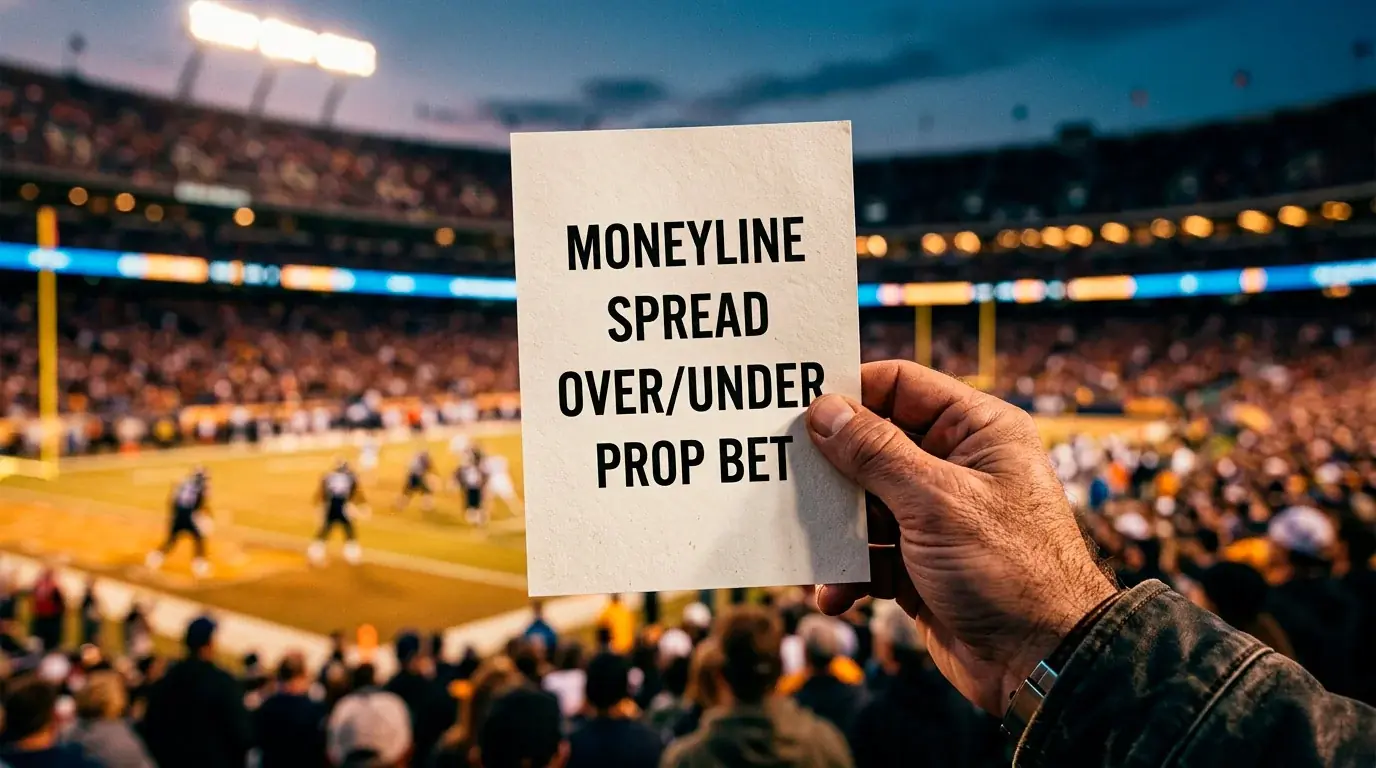
Beyond the traditional moneyline and spread, the big game is famous for its Super Bowl novelty prop bets, ranging from the coin toss to the halftime show.
Created by the ”Bets for nfl” editorial team.